
Custom antenna design is essential in the development of electronic devices to ensure optimal performance in their intended environments.
While off-the-shelf antennas may offer convenience, they often underperform when integrated into specific devices. Factors such as mechanical constraints, nearby metals, plastics and other variables can significantly affect performance. For example, even if a commercial antenna exhibits strong specifications, its performance may degrade when integrated into a device with a ground plane shape and size different from those defined in the manufacturer’s datasheet. This can negatively impact impedance matching, efficiency and gain pattern.
When the system is implemented on a PCB, designing the antenna as a printed structure can be advantageous. This approach eliminates additional component costs and enables tight integration with the overall system and mechanical design, resulting in improved and more predictable antenna performance.
We provide end-to-end antenna development services, including:
- Assistance with specification definition
- Theoretical analysis and modeling
- Design and optimization using Ansys simulation tools, such as HFSS and Circuit
- Impedance matching network design
- Complete prototype development, including mechanical design
- Prototype implementation and manufacturing
- Antenna measurement and performance validation
- Engineering support during mass production
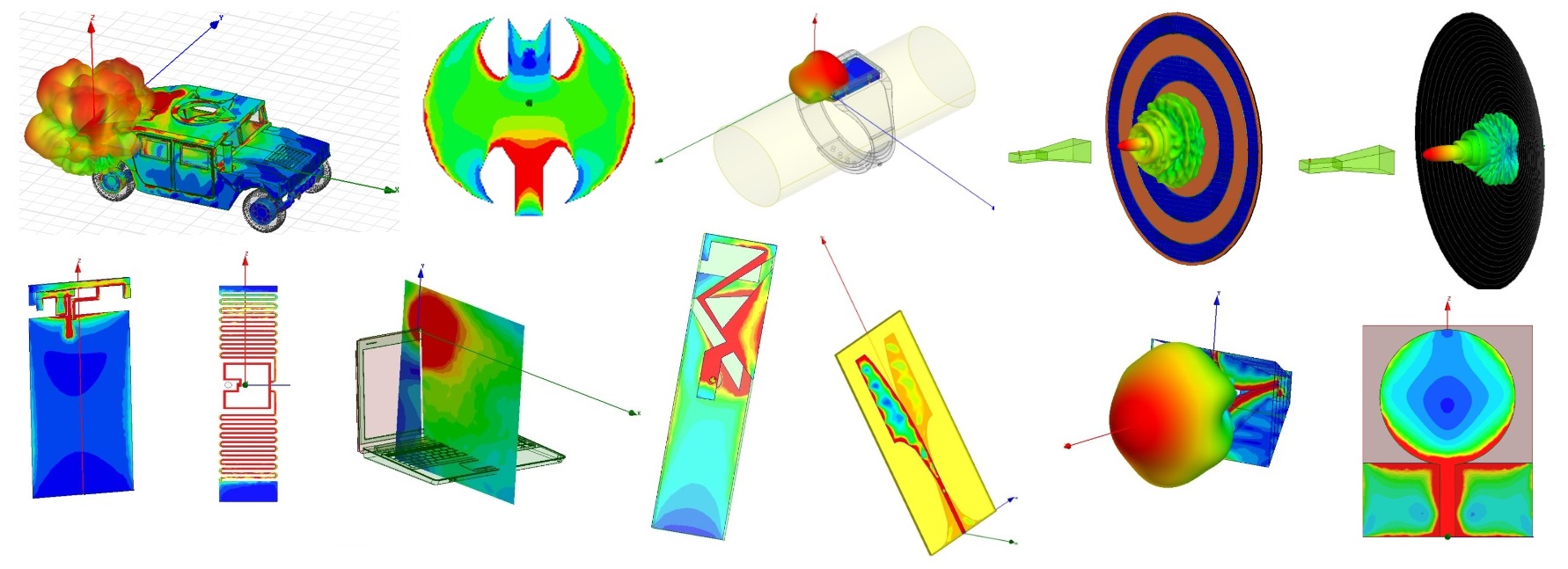
Over the years, we have designed and manufactured a wide range of antennas for diverse applications, including:
- Cellular communication, including 5G networks
- Wi-Fi, BLE, and LoRa communication
- 24 GHz, 60 GHz and 79 GHz bands for automotive radar
- Medical telemetry systems
- Ultra-Wideband (UWB) systems
- GPS navigation systems
- Internet of Things (IoT) devices
- Drone communication and telemetry
- ISM band applications
- RFID systems for both readers and tags
- Aviation communication systems
- Defense communication systems
- Radar systems
- Smart home devices
- and more
The antenna solutions we develop include:
- Printed antennas
- Miniaturized antennas
- RFID antennas for tags and readers
- Integrated antennas for IoT and embedded devices
- Wideband, dual-band and multi-band antennas
- Waveguide-based antennas
- Installed antenna pattern analysis
- Antenna arrays with feeding networks
- Antenna and phased-array systems with beamforming
- and more
Sometimes, design requirements require the use of antenna arrays, which can be categorized into several main types:
Antennas with a feeding network: This design is often used when higher gain and a narrower beamwidth are required in the azimuth plane, elevation plane or both.
Phased Array Antennas: In this configuration, each antenna element, or a group of elements, is excited with controlled magnitude and phase. This enables dynamic electronic beam steering of the main lobe, as well as control of beamwidth and sidelobe levels. In addition, null steering can be implemented, which is particularly useful for mitigating interference.
MIMO Radar Antennas: In Multiple-Input Multiple-Output (MIMO) radar systems, including those based on Frequency-Modulated Continuous-Wave (FMCW) techniques, enhancing spatial resolution without increasing the number of transmitters and receivers is a key objective. Common implementations use techniques such as Time-Division Multiplexing (TDM). For optimal target detection, it is important to maintain similar gain and phase responses across all transmitting (Tx) and receiving (Rx) antennas over the entire operating frequency range.
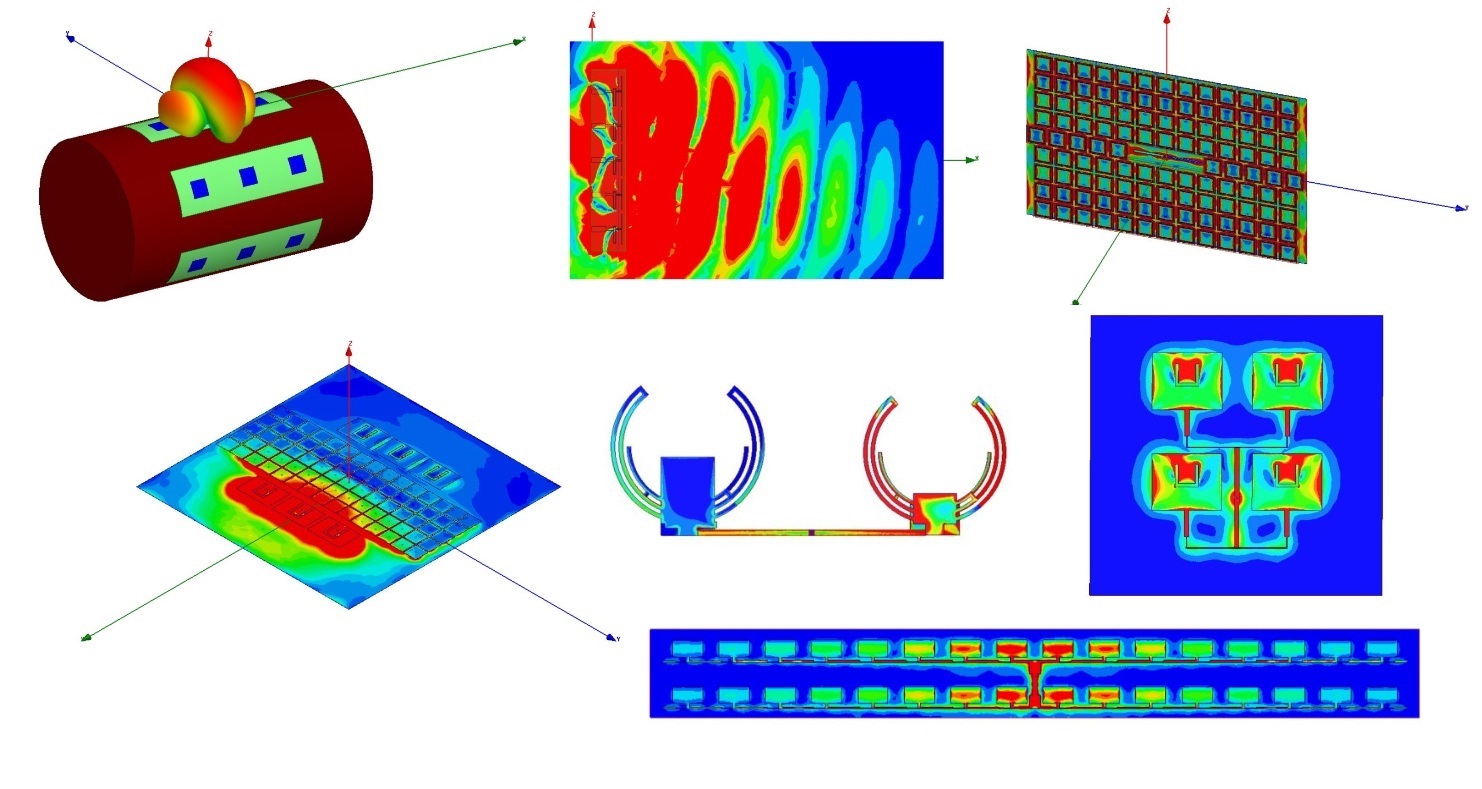
We have extensive expertise in the design of a wide range of antenna array systems. Our experience includes signal processing for beam scanning and null steering, as well as virtual array design for MIMO radar applications.